

- Beranda
- Komunitas
- News
- Ilmu Marketing & Research
Global Battery Management System Market Analysis and Forecast, 2025 to 2034


TS
benziminkara586
Global Battery Management System Market Analysis and Forecast, 2025 to 2034
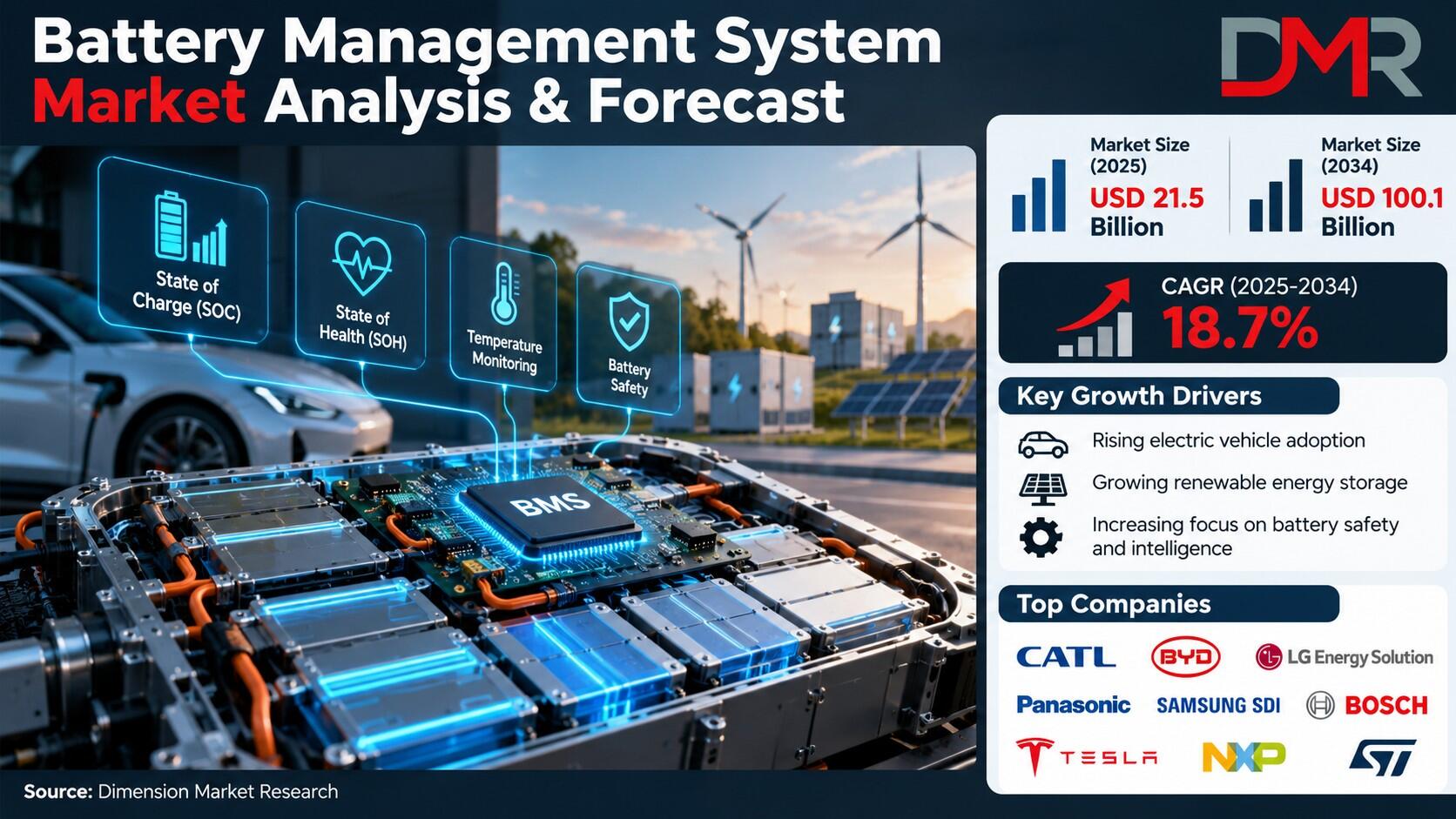
Battery Management System Market Overview
According to Dimension Market Research, the Battery Management System Market is projected to reach USD 21.5 billion in 2025 and grow at a compound annual growth rate (CAGR) of 18.7% from 2025 to 2034, reaching USD 100.1 billion by 2034. This expansion reflects the growing importance of battery monitoring, safety, and performance optimization as electric mobility and energy storage become increasingly central to industrial development and the clean energy transition. Battery management systems (BMS) are electronic platforms that monitor battery voltage, current, temperature, state of charge (SOC), and state of health (SOH).
They help protect battery packs against overcharging, excessive discharge, overheating, and other operating risks while improving energy utilization and battery life. Their applications span electric vehicles, renewable energy storage, consumer electronics, industrial backup power, and commercial fleets. As lithium-ion batteries become more widely deployed, demand is increasing for intelligent monitoring, precise cell balancing, predictive maintenance, and connected battery analytics. Wireless architectures, artificial intelligence, and cloud-based diagnostics are also creating opportunities for advanced BMS solutions through 2034.
Battery Management System Market Snapshot
- Global market value: USD 21.5 billion in 2025.
- Projected market value: USD 100.1 billion by 2034.
- Forecast CAGR: 18.7% during 2025 to 2034.
- US market value: USD 6.7 billion in 2025.
- US forecast value: USD 28.9 billion by 2034.
- US market CAGR: 17.5% during 2025 to 2034.
- Europe market value: USD 3.02 billion in 2025.
- Japan market value: USD 560 million in 2025.
- Historical market data: 2019 to 2024.
- Forecast period: 2026 to 2034.
Get free sample of this report (with custom data option): [url]https://dimensionmarketresearch.com/request-sample/battery-management-system-market/[/url]
Market Research Findings
The Battery Management System Market research highlights the increasing role of battery intelligence across electric mobility and stationary energy storage. Distributed BMS architectures are positioned to benefit from demand for scalable monitoring, localized fault detection, and improved battery pack safety. Electric vehicle battery management represents the leading application segment, supported by the expansion of passenger EVs, commercial fleets, and high-voltage battery platforms. Grid-scale storage is another important growth area as utilities seek reliable ways to manage renewable energy variability and improve grid flexibility. The report also examines centralized, modular, hybrid, and wireless BMS architectures, along with demand from vehicle manufacturers, utilities, fleet operators, and industrial customers. Artificial intelligence, predictive diagnostics, and connected monitoring are emerging as important technology differentiators.
Why Is the Battery Management System Market Growing?
Market growth is closely linked to the expanding deployment of rechargeable batteries in transportation, electricity networks, and industrial equipment. Electric vehicles require accurate cell monitoring, thermal control, and charge optimization to deliver dependable range and safe operation. At the same time, solar and wind power projects increasingly depend on battery storage to balance electricity supply and demand. Battery management systems support these applications by improving charge and discharge control, tracking battery degradation, and detecting operating abnormalities.
Manufacturers are also investing in advanced battery chemistries, wireless communication, and software-based diagnostics. These developments increase the need for BMS platforms capable of managing larger packs, supporting remote monitoring, and improving lifecycle performance. Government electrification initiatives and battery safety requirements further encourage adoption across established and emerging markets.
Battery Management System Market Key Growth Drivers
- Increasing electric vehicle adoption across passenger and commercial fleets.
- Growing renewable energy storage and grid modernization investments.
- Rising demand for battery safety, cell balancing, and thermal protection.
- Expansion of lithium-ion battery manufacturing and gigafactory capacity.
- Advances in AI-powered diagnostics and predictive battery maintenance.
- Growing use of battery storage in industrial and residential applications.
- Increasing need for battery lifecycle tracking and second-life applications.
Battery Management System Market Research Scope and Analysis
The report evaluates the market by system type, application, and end user, providing a framework for understanding how technology choices and battery deployment patterns influence demand. Two segments stand out because of their close connection to electric mobility, system safety, and expanding energy storage requirements.
Distributed Battery Management System
Distributed BMS is projected to dominate the market by type, according to the supplied report. This architecture places monitoring and control functions at the cell or module level, enabling detailed measurements and localized responses to battery abnormalities. It is particularly relevant to high-capacity electric vehicle batteries and large stationary storage installations, where accurate monitoring and fault isolation are important.
Distributed architectures can support modular pack designs, improve serviceability, and help manufacturers scale battery systems across different applications. As battery packs become more complex, manufacturers increasingly need flexible solutions for voltage measurement, temperature monitoring, cell balancing, and thermal risk management.
- Supports detailed cell and module monitoring.
- Enables localized fault detection and isolation.
- Offers scalability for large battery installations.
- Supports flexible battery pack integration.
Electric Vehicle Battery Management
Electric vehicle battery management is identified as the leading application segment in the supplied report. EV battery packs require continuous supervision to maintain safe operating limits, optimize charging, and support predictable vehicle performance. BMS platforms estimate SOC and SOH, regulate cell balancing, monitor temperature, and communicate battery information to vehicle control systems.
As automakers expand battery-electric and plug-in hybrid vehicle portfolios, they need systems that can accommodate different pack sizes, battery chemistries, charging speeds, and vehicle operating conditions. Advanced BMS capabilities can also help reduce degradation, support battery warranty management, and improve the reliability of commercial electric fleets.
- Improves battery monitoring and charging control.
- Supports thermal protection and fault detection.
- Helps optimize usable battery capacity and longevity.
- Enables diagnostics for commercial fleet operations.
Read more about this market: Battery Management System Market Research Report
https://dimensionmarketresearch.com/...system-market/
Battery Management System Market Dynamics
Market Trends
One important trend is the transition toward intelligent, connected battery management. Wireless BMS architectures can reduce wiring requirements and simplify battery pack assembly, while cloud-connected platforms support remote monitoring and fleet-level diagnostics. Artificial intelligence is also being applied to SOC and SOH estimation, anomaly detection, degradation forecasting, and charging optimization. These functions help manufacturers and operators make better-informed decisions throughout the battery lifecycle. Improved communication standards and digital battery records may further support interoperability, traceability, and second-life battery deployment.
Market Opportunities
Second-life battery applications offer opportunities for BMS suppliers as retired electric vehicle batteries are evaluated for stationary storage and other lower-demand uses. Accurate health assessment, module balancing, and lifecycle tracking can help determine whether batteries are suitable for reuse or recycling. Commercial fleet electrification also creates demand for BMS platforms that combine remote diagnostics, charging schedules, predictive maintenance, and fleet management integration. Vendors offering software subscriptions and analytics services may develop recurring revenue opportunities alongside traditional hardware sales. Residential storage, industrial backup systems, and renewable energy installations provide additional avenues for expansion.
Market Challenges
High development costs and integration complexity remain important barriers. Advanced battery management requires precise sensors, control electronics, software algorithms, safety validation, and compatibility with specific battery chemistries. Custom engineering can increase development timelines and costs, especially for manufacturers supporting multiple battery platforms. Regulatory and communication requirements also differ across applications and markets, creating additional compliance work for international suppliers. Interoperability between batteries, charging equipment, and energy management systems can be difficult when proprietary interfaces are used. Manufacturers must therefore balance performance, cost, cybersecurity, and safety while adapting to changing technical standards.
Battery Management System Market Regional and Country Outlook
North America is projected to account for approximately 37.3% of global market share in 2025, according to the supplied report. Asia-Pacific is identified as the region with the highest growth potential, supported by battery manufacturing capacity, electric vehicle adoption, and energy storage deployment. The following country-level figures are provided in the research material.
- United States: USD 6.7 billion in 2025, projected to reach USD 28.9 billion by 2034, at a CAGR of 17.5%.
- Europe: USD 3.02 billion in 2025, projected to reach USD 12.72 billion by 2034, at a CAGR of 17.5%.
- Japan: USD 560 million in 2025, projected to reach USD 2.91 billion by 2034, at a CAGR of 20.0%.
Regional demand reflects differences in automotive manufacturing, battery supply chains, regulatory priorities, and renewable energy investment. North America benefits from EV and stationary storage development, Europe from electrification and battery sustainability requirements, and Japan from its automotive engineering and battery technology capabilities.
Battery Management System Market: Key Competitor Companies
The competitive landscape includes battery manufacturers, automotive technology companies, semiconductor suppliers, and specialist BMS developers. Key companies identified in the supplied report include:
- LG Energy Solution
- Panasonic Corporation
- CATL
- BYD Company Limited
- Samsung SDI
- Tesla, Inc.
- Bosch
- Texas Instruments
- NXP Semiconductors
- Infineon Technologies AG
- Analog Devices, Inc.
- Renesas Electronics Corporation
- STMicroelectronics
- Sensata Technologies
- Eberspächer
- Leclanché SA
- Elithion, Inc.
- Nuvation Energy
- Wärtsilä Energy
- Fluence Energy
- Sungrow Power Supply Co., Ltd.
Get 10% instant discount on report purchase
Explore more reports:
- Liquid Crystal Polymer Market
- Linear Actuators Market
- LCD TV Core Chip Market
- Laser Marking Machine Market
Frequently Asked Questions (FAQs)
1. What is the Battery Management System Market?
The Battery Management System Market covers technologies that monitor, protect, and optimize batteries used in EVs, energy storage, electronics, and industrial equipment.
2. What is the global Battery Management System Market size in 2025?
According to the supplied Dimension Market Research report, the global market is projected to reach USD 21.5 billion in 2025.
3. What is the Battery Management System Market forecast for 2034?
The market is projected to reach USD 100.1 billion by 2034, growing at a reported CAGR of 18.7% from 2025 to 2034.
4. What are the key factors driving Battery Management System Market growth?
EV adoption, renewable energy storage, battery safety requirements, advanced lithium-ion batteries, and intelligent battery analytics are key growth factors.
5. Which segment leads the Battery Management System Market?
The supplied report identifies distributed BMS as the leading type segment and electric vehicle battery management as the leading application segment.
6. Which region dominates the Battery Management System Market?
North America is projected to hold approximately 37.3% of global market share in 2025, according to the supplied report.
7. What is the growth outlook for the US Battery Management System Market?
The US market is projected to grow from USD 6.7 billion in 2025 to USD 28.9 billion in 2034, at a CAGR of 17.5%.
8. What technologies are shaping the Battery Management System Market?
Wireless BMS, artificial intelligence, cloud diagnostics, predictive maintenance, digital battery records, and advanced thermal management are shaping the market.
9. What challenges affect the Battery Management System Market?
High integration costs, complex battery architectures, cybersecurity requirements, and fragmented standards can challenge BMS manufacturers and system integrators.
10. Who are the key companies in the Battery Management System Market?
Key companies include LG Energy Solution, Panasonic, CATL, BYD, Samsung SDI, Tesla, Bosch, Texas Instruments, NXP Semiconductors, and Infineon Technologies.
About Us
Dimension Market Research (DMR) is a global market intelligence and consulting firm delivering data-driven insights that help organizations make informed strategic decisions. With expertise across 12+ industries and global markets, DMR provides syndicated reports, custom research, competitive analysis, white space analysis, and business strategy consulting.
Our research solutions combine analytical rigor, industry expertise, and forward-looking intelligence to identify opportunities, reduce risks, and support sustainable growth. Trusted by clients across diverse sectors, DMR is committed to delivering accurate, actionable insights that enable businesses to navigate evolving market landscapes with confidence.
Contact Us
Phone USA: +17323699777
Phone India: +919310023843
E-mail: enquiry@dimensionmarketresearch.com
Address USA: 957 Route 33, Suite 12 #308, Hamilton Square, NJ-08690
Address India: D44, Sector 6, Noida 201301, India
0
13
0

Komentar yang asik ya
Komentar yang asik ya
Komunitas Pilihan