



TS
bobb123
flying formation
formation flying, two or more aircraft traveling and maneuvering together in a disciplined, synchronized, predetermined manner. In a tight formation, such as is typically seen at an air show, aircraft may fly less than three feet (one metre) apart and must move in complete harmony, as if they are joined together.
Formation flying developed in World War I, when fighter aircraft escorted reconnaissance aircraft over enemy territory. Fighter squadrons soon discovered that fighting in pairs reduced their losses and increased their victories.
Echelon Formation
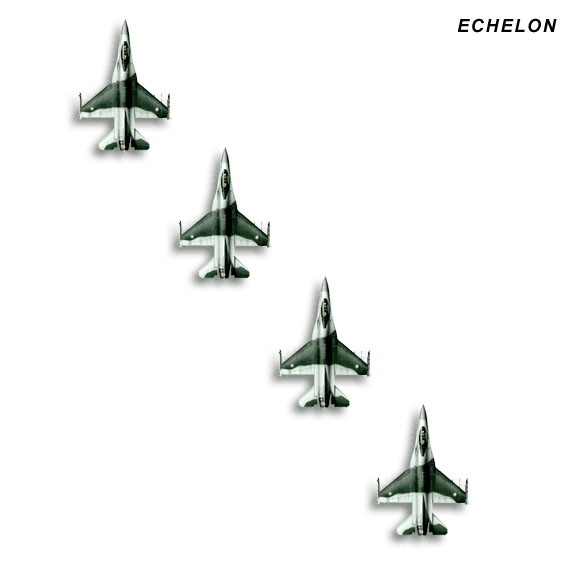
An echelon formation is a (usually military) formation in which its units are arranged diagonally. Each unit is stationed behind and to the right (a "right echelon"), or behind and to the left ("left echelon"), of the unit ahead. The name of the formation comes from the French word échelon, meaning the rungs of ladder, which describes the shape that this formation has when viewed from above or below.
Use of the formation dates back to ancient infantry and cavalry warfare when attempting to flank an enemy or to break one wing with overwhelming numbers. One of the earliest uses was at the Battle of Leuctra when the Thebans attacked the Spartan right with a column 48 men deep while their weaker center and right were refused. The echelon formation was also used by Hannibal at the Battle of Cannae, and by Frederick II of Prussia.

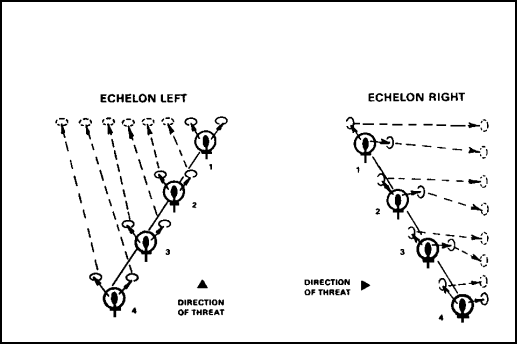
MOVEMENT TO LINE FROM LEFT, HEAVY RIGHT FORMATION.
The tactic persists up to the present day, where it is regularly employed by all branches of the modern armed forces. Tactically, echelon formations are used because of the excellent range of vision offered to each participant in the formation.
In particular, it is commonly employed by armored cavalry because of the large, overlapping fields of fire that it gives to each tank in the formation, and by combat aircraft, where the close, streamlined flight formation can allow the planes to dramatically reduce fuel consumption by "surfing" the updraft created by the wingtip vortices of the aircraft ahead.
V Formation
Visual contact is why V formations (and the asymmetric echelon formations) are also commonly adopted by flights of military aircraft engaged on a common mission.
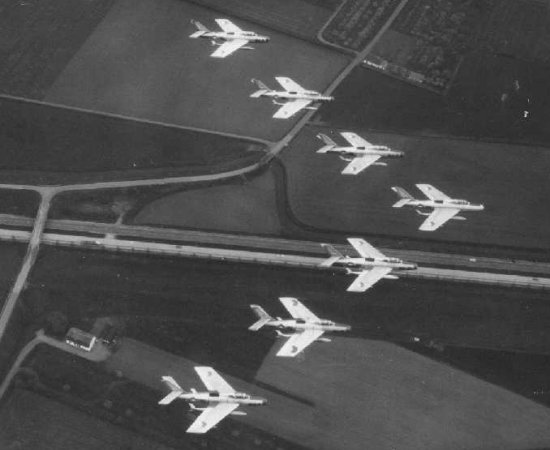
The basic flight formation for military aircraft in many air forces during World War II was a V formation. In the U.S. Army Air Forces, the most basic formation for bombers was a three-plane "V" called an "element". Stacks of these elements were configured to form a defensive bombing formation called the "combat box". The standard fighter unit, early in World War II, for the British Royal Air Force was the V shaped "vic". This involved one lead plane and two wingmen, with the wingmen flying very close to the sides and slightly behind the lead plane to form the V shape. Typically four vics would fly together one after another to form a squadron. The problem with the vics were the formations were so tight that the wingmen had to constantly be watching the lead plane or risk running into them. This left only the lead plane to search the skies for enemy planes. After many complaints from the British pilots of the vics not being the optimal flying formation, the RAF Fighter Command changed the squadron formation so the fourth vic would weave back and forth theoretically giving them a better field of view. This resulted in the "weavers" as they were called being picked off because the German fighters could attack them and get away before the rest of the squadron could leave formation and be ready for a counterattack. The Germans called these vics Idiotenreihen ("rows of idiots"). Later in the war the RAF Fighter Command abandoned the vic formations in favor of the Fingertip formation that the German Air Force (Luftwaffe) used.
The V formation is also common in ceremonial flyovers and airshow flights.
Air Mobility Command, which accounts for 20 percent of federal fuel usage, is experimenting with autopilot changes to find the best tradeoff between the reduced drag of 'vortex surfing' and the resulting 'ride qualities' of flying through another aircraft's wake
Fingertip Formation
fingertip formation also know as finger four formation, this is a flight formation used by fighter aircraft. It consists of four aircraft, and four of these formations can be combined into a squadron formation.
The formation was developed by several air forces independently in the 1930s. The Finnish Air Force adopted it during 1934-1935. Luftwaffe pilots developed the formation independently in 1938 during the Spanish Civil War, and were the first to use it in combat.


Most notable in its development and use in the Luftwaffe was Werner Mölders and his fellow airmen. In the German Luftwaffe the flight was made up of two pairs of aircraft. Each Rotte was composed of a leader and a wingman. The aircraft in the Schwarm had greater vertical and horizontal separation, so they were free to scan in all directions for enemy aircraft rather than focusing on maintaining a close formation.
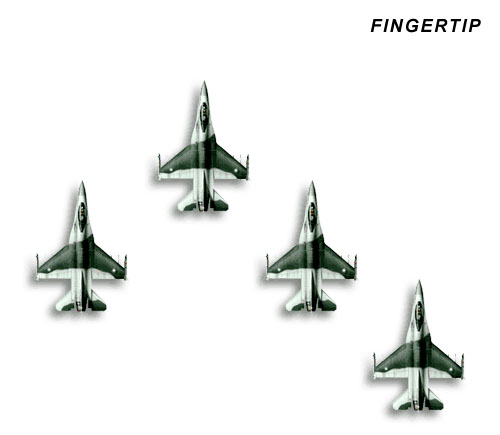
This allowed the pilots to maintain greater situational awareness and reduce the chance of being spotted by the enemy due to the looser formation The formation consists of a flight of four aircraft, composed of a "lead element" and a "second element", each of two aircraft. When viewing the formation from above, the positions of the planes resemble the tips of the four fingers of a human right hand (without the thumb), giving the formation its name.
The lead element is made up of the flight leader at the very front of the formation and one wingman to his rear left. The second element is made up of an additional two planes, the element leader and his wingman. The element leader is to the right and rear of the flight leader, followed by the element wingman to his right and rear.
Both the flight leader and element leader have offensive roles, in that they are the ones to open fire on enemy aircraft while the flight remains intact. Their wingmen have a defensive role — the flight wingman covers the rear of the second element and the element wingman covers the rear of the lead element.
Four of these flights can be assembled to form a squadron formation which consists of two staggered lines of fighters, one in front of the other. Each flight is usually designated by a color (RGB+Yellow)
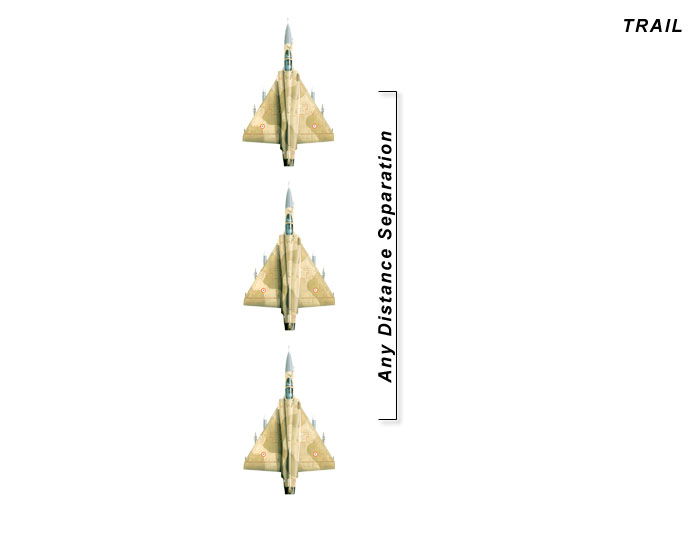
Trail Formation
This formation also known as Line Astern Formation in which all aircraft are in single file, each directly behind the other.
Line Astern is normally only used as a transition between other formations. For example, to go from Finger Right to Finger Left, Lead would first change to Line Astern, then to Finger Left.
Line Astern is also used for "top side" (turning) parade passes, where it looks quite sharp.
Combat Box Formation
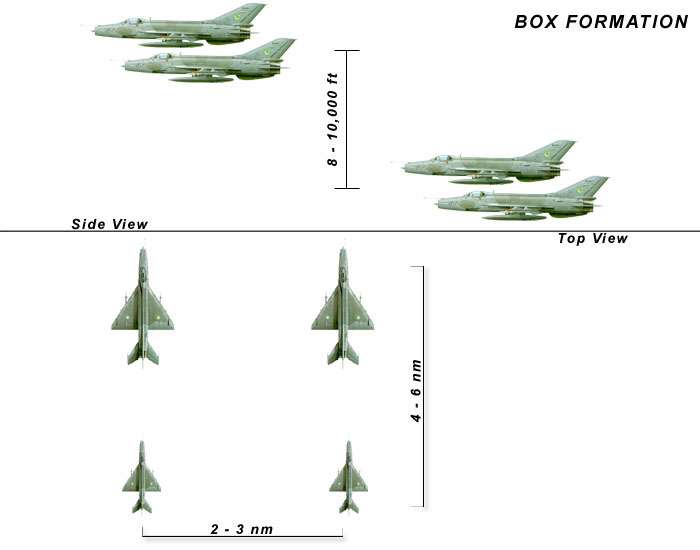
The Combat Box was a tactical formation used by heavy (strategic) bombers of the U.S. Army Air Forces during World War II. The combat box was also referred to as a "staggered formation". Its defensive purpose was in massing the firepower of the bombers' guns, while offensively it concentrated the release of bombs on a target.
Creation of the concept is credited to Colonel Curtis E. LeMay, commander of the 305th Bombardment Group in England.However the Eighth Air Force had been experimenting with different tactical formations since its first bombing mission on 17 August 1942, several of which were also known as "boxes." LeMay's group did create the "Javelin Down" combat box in December 1942, and that formation became the basis for the numerous variations of combat boxes that followed

Combat box of a 12-plane B-17 squadron developed in October 1943. Three such boxes completed a 36-plane group box.
1. Lead Element
2. High Element
3. Low Element
4. Low Low Element
During the winter of 1944-45, minimizing losses to flak became a priority. The 27-plane box became standard for B-17s for all of 1945, spread more laterally to avoid catastrophic damage to the formation from a single shell burst. At the same time wingmen flew more forward on element leaders, creating a box that was stacked 750 ft (230 m) vertically, 650 ft (200 m) from front to back, and 1,170 ft (360 m) laterally. This final variation presented flak gunners with a small target, produced excellent bomb patterns, and was both easy to fly and control.
The box having both an offensive and defensive nature:
1. Offensive - - "concentrated the release of bombs on a target"
2. Defensive - - "massing the firepower of the bombers' guns"
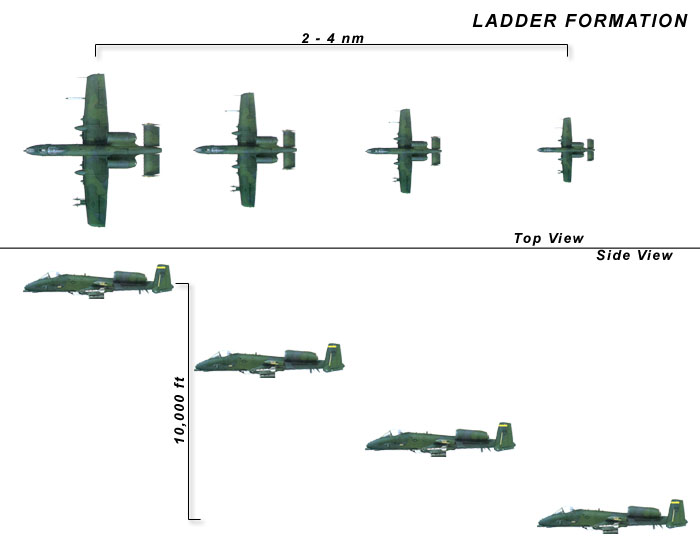
Ladder Formation
Fluid Four Formation

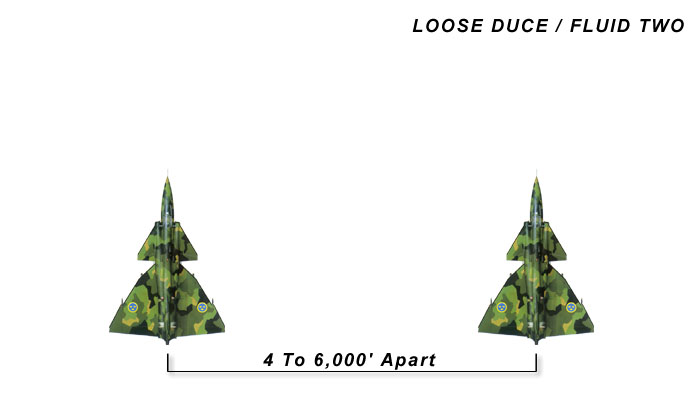
Fluid Two Formation
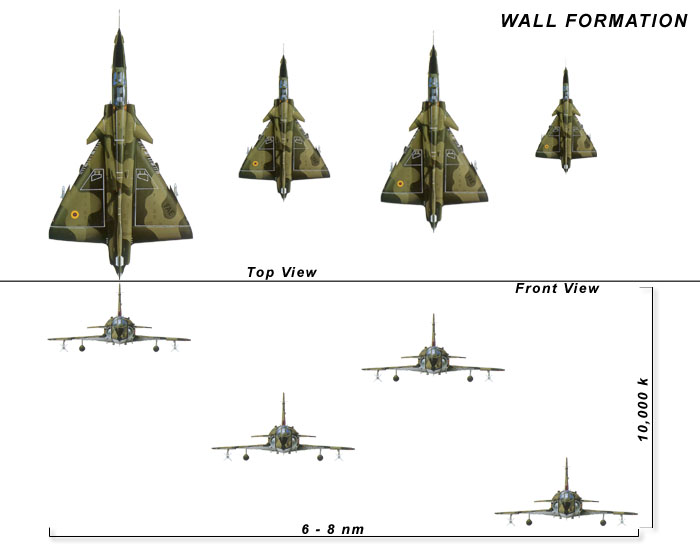
Wall Formation
http://www.globalsecurity.org
http://www.combataircraft.com
http://en.wikipedia.org
http://www.aerospaceweb.org
Formation flying developed in World War I, when fighter aircraft escorted reconnaissance aircraft over enemy territory. Fighter squadrons soon discovered that fighting in pairs reduced their losses and increased their victories.
Echelon Formation
Spoiler for echeloning:
An echelon formation is a (usually military) formation in which its units are arranged diagonally. Each unit is stationed behind and to the right (a "right echelon"), or behind and to the left ("left echelon"), of the unit ahead. The name of the formation comes from the French word échelon, meaning the rungs of ladder, which describes the shape that this formation has when viewed from above or below.
Use of the formation dates back to ancient infantry and cavalry warfare when attempting to flank an enemy or to break one wing with overwhelming numbers. One of the earliest uses was at the Battle of Leuctra when the Thebans attacked the Spartan right with a column 48 men deep while their weaker center and right were refused. The echelon formation was also used by Hannibal at the Battle of Cannae, and by Frederick II of Prussia.
Spoiler for echelon formation:
The echelon formation ( Figure B-4 ) is an offensive formation. It is used to turn or divert groups in open or built-up areas and to move crowds away from buildings, fences, and walls. An echelon formation can be an echelon right or an echelon left, depending on the direction in which the crowd is to be moved.
MOVEMENT TO LINE FROM LEFT, HEAVY RIGHT FORMATION.
The tactic persists up to the present day, where it is regularly employed by all branches of the modern armed forces. Tactically, echelon formations are used because of the excellent range of vision offered to each participant in the formation.
In particular, it is commonly employed by armored cavalry because of the large, overlapping fields of fire that it gives to each tank in the formation, and by combat aircraft, where the close, streamlined flight formation can allow the planes to dramatically reduce fuel consumption by "surfing" the updraft created by the wingtip vortices of the aircraft ahead.
V Formation
Visual contact is why V formations (and the asymmetric echelon formations) are also commonly adopted by flights of military aircraft engaged on a common mission.
Spoiler for V formation:
The basic flight formation for military aircraft in many air forces during World War II was a V formation. In the U.S. Army Air Forces, the most basic formation for bombers was a three-plane "V" called an "element". Stacks of these elements were configured to form a defensive bombing formation called the "combat box". The standard fighter unit, early in World War II, for the British Royal Air Force was the V shaped "vic". This involved one lead plane and two wingmen, with the wingmen flying very close to the sides and slightly behind the lead plane to form the V shape. Typically four vics would fly together one after another to form a squadron. The problem with the vics were the formations were so tight that the wingmen had to constantly be watching the lead plane or risk running into them. This left only the lead plane to search the skies for enemy planes. After many complaints from the British pilots of the vics not being the optimal flying formation, the RAF Fighter Command changed the squadron formation so the fourth vic would weave back and forth theoretically giving them a better field of view. This resulted in the "weavers" as they were called being picked off because the German fighters could attack them and get away before the rest of the squadron could leave formation and be ready for a counterattack. The Germans called these vics Idiotenreihen ("rows of idiots"). Later in the war the RAF Fighter Command abandoned the vic formations in favor of the Fingertip formation that the German Air Force (Luftwaffe) used.
The V formation is also common in ceremonial flyovers and airshow flights.
Air Mobility Command, which accounts for 20 percent of federal fuel usage, is experimenting with autopilot changes to find the best tradeoff between the reduced drag of 'vortex surfing' and the resulting 'ride qualities' of flying through another aircraft's wake
Fingertip Formation
fingertip formation also know as finger four formation, this is a flight formation used by fighter aircraft. It consists of four aircraft, and four of these formations can be combined into a squadron formation.
The formation was developed by several air forces independently in the 1930s. The Finnish Air Force adopted it during 1934-1935. Luftwaffe pilots developed the formation independently in 1938 during the Spanish Civil War, and were the first to use it in combat.
Spoiler for The Fingertip/FingerFour:
Most notable in its development and use in the Luftwaffe was Werner Mölders and his fellow airmen. In the German Luftwaffe the flight was made up of two pairs of aircraft. Each Rotte was composed of a leader and a wingman. The aircraft in the Schwarm had greater vertical and horizontal separation, so they were free to scan in all directions for enemy aircraft rather than focusing on maintaining a close formation.
This allowed the pilots to maintain greater situational awareness and reduce the chance of being spotted by the enemy due to the looser formation The formation consists of a flight of four aircraft, composed of a "lead element" and a "second element", each of two aircraft. When viewing the formation from above, the positions of the planes resemble the tips of the four fingers of a human right hand (without the thumb), giving the formation its name.
The lead element is made up of the flight leader at the very front of the formation and one wingman to his rear left. The second element is made up of an additional two planes, the element leader and his wingman. The element leader is to the right and rear of the flight leader, followed by the element wingman to his right and rear.
Both the flight leader and element leader have offensive roles, in that they are the ones to open fire on enemy aircraft while the flight remains intact. Their wingmen have a defensive role — the flight wingman covers the rear of the second element and the element wingman covers the rear of the lead element.
Four of these flights can be assembled to form a squadron formation which consists of two staggered lines of fighters, one in front of the other. Each flight is usually designated by a color (RGB+Yellow)
Trail Formation
This formation also known as Line Astern Formation in which all aircraft are in single file, each directly behind the other.
Line Astern is normally only used as a transition between other formations. For example, to go from Finger Right to Finger Left, Lead would first change to Line Astern, then to Finger Left.
Line Astern is also used for "top side" (turning) parade passes, where it looks quite sharp.
Spoiler for Trail formation:
Combat Box Formation
The Combat Box was a tactical formation used by heavy (strategic) bombers of the U.S. Army Air Forces during World War II. The combat box was also referred to as a "staggered formation". Its defensive purpose was in massing the firepower of the bombers' guns, while offensively it concentrated the release of bombs on a target.
Spoiler for Combat Box Formation:
Creation of the concept is credited to Colonel Curtis E. LeMay, commander of the 305th Bombardment Group in England.However the Eighth Air Force had been experimenting with different tactical formations since its first bombing mission on 17 August 1942, several of which were also known as "boxes." LeMay's group did create the "Javelin Down" combat box in December 1942, and that formation became the basis for the numerous variations of combat boxes that followed
Spoiler for Combat Box Formation:
Combat box of a 12-plane B-17 squadron developed in October 1943. Three such boxes completed a 36-plane group box.
1. Lead Element
2. High Element
3. Low Element
4. Low Low Element
During the winter of 1944-45, minimizing losses to flak became a priority. The 27-plane box became standard for B-17s for all of 1945, spread more laterally to avoid catastrophic damage to the formation from a single shell burst. At the same time wingmen flew more forward on element leaders, creating a box that was stacked 750 ft (230 m) vertically, 650 ft (200 m) from front to back, and 1,170 ft (360 m) laterally. This final variation presented flak gunners with a small target, produced excellent bomb patterns, and was both easy to fly and control.
The box having both an offensive and defensive nature:
1. Offensive - - "concentrated the release of bombs on a target"
2. Defensive - - "massing the firepower of the bombers' guns"
Ladder Formation
Spoiler for Ladder Formation:
Fluid Four Formation
Spoiler for Fluid Four:
Fluid Two Formation
Spoiler for Fluid Two:
Wall Formation
Spoiler for Wall Formation:
Spoiler for Note dari TS:
http://www.globalsecurity.org
http://www.combataircraft.com
http://en.wikipedia.org
http://www.aerospaceweb.org
Diubah oleh bobb123 13-01-2014 19:06
0
4.3K
15
Thread Digembok
Urutan
Terbaru
Terlama
Thread Digembok
Komunitas Pilihan